
Most owners learn about a lease renewal after it’s signed. The resident agreed, the rent went up a little, and the new figure showed up on the next statement. Nobody showed them how that number was chosen or what the home would lease for if it came vacant tomorrow.
For the single-family homes we manage, that number now comes with a written rent recommendation. Before a renewal offer goes out, the owner gets a one-page report on that specific home. Homes on a month-to-month lease get one too, and so does any home that comes vacant.
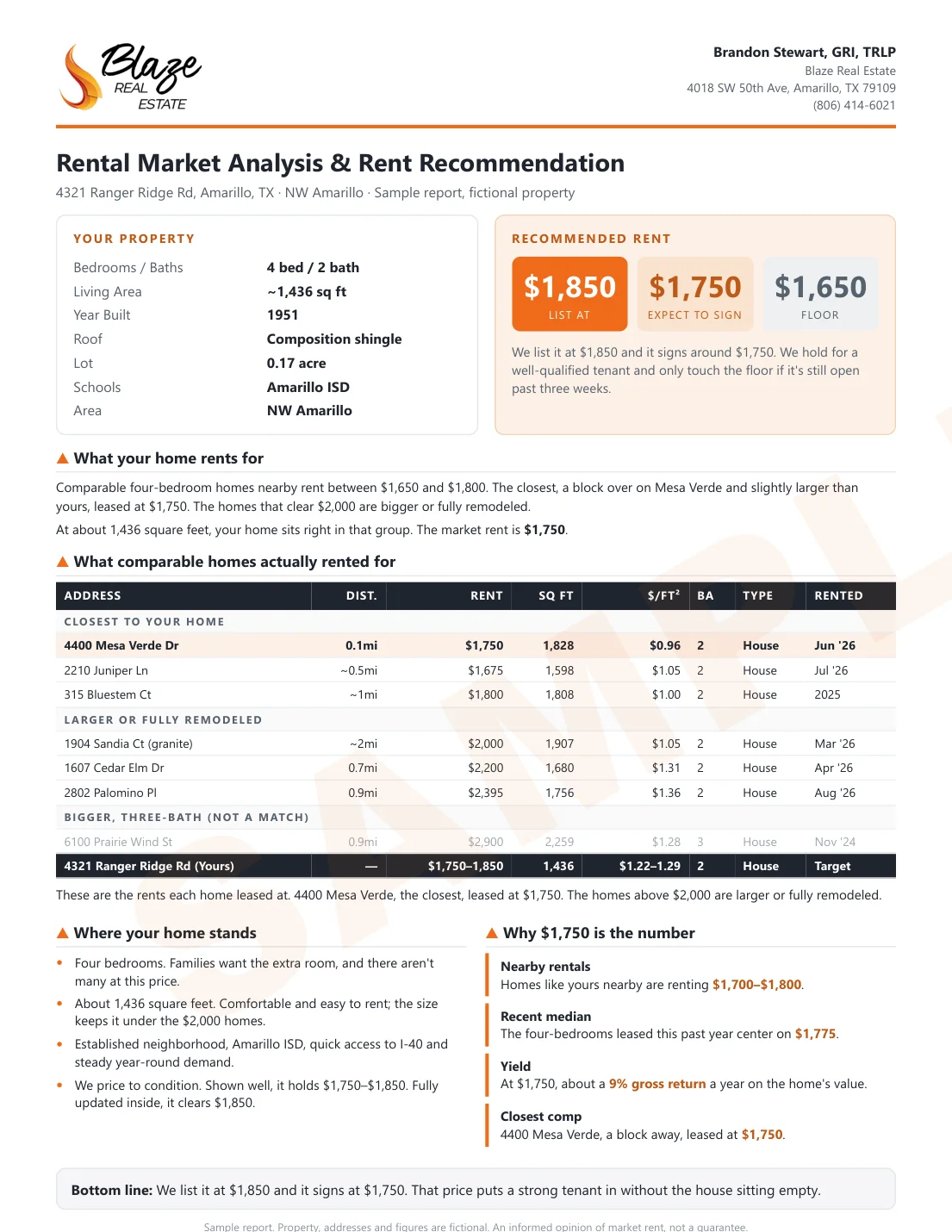
What’s on the page
Three numbers sit at the top:
- Market rent: what the home would lease for today if it were empty and marketed well.
- Renewal rent: what we recommend offering the current resident to stay.
- List if vacant: where marketing would start if the resident moves out, with a floor under it.
Below them is the evidence: comparable homes that actually leased nearby, each with its rent, size, bedrooms and baths, and when it leased. The market figure comes from a comprehensive review of the local market using multiple sources, including recent signed leases. When a cheaper rental nearby isn’t a fair comparison, such as a duplex unit or a much older house, the page names it and explains why it was set aside, so you can check our work line by line.
The page also lists what your home has going for it, like a second bathroom, a garage the nearby rentals don’t have, or a bigger lot. It closes with a short bottom line that includes the gross yield on the county’s appraised value.
Why market rent and renewal rent are two numbers
A resident who has been in a home for several years is often well below market. On some homes we reviewed this month, the current rent was more than $400 below what the same floor plan leases for down the street. No single renewal caused that. The gap builds a little each year when a home is never priced against the market again.
Closing the whole gap in one renewal is rarely the best result for the owner. A big jump often ends in a move-out, and a move-out brings turn costs, vacant weeks and a leasing fee. So the renewal rent is a measured step toward market, and the page shows it next to the market rent so you can see how much ground is left. We also record the market rent on the unit in our accounting system, so your reports show what the home could earn as well as what it earns today.
The same rule for every resident
The renewal increase comes from one written rule, applied the same way to every resident in every home. Who the resident is, how long they’ve lived there and whether anyone likes them have no bearing on the number. That’s a fair-housing commitment, and it means the number holds up if anyone asks how it was reached. When a renewal does need to differ from the rule, I make that call and write down the reason, and the reason has to be about the property or the owner’s instructions.
Payment history, stated plainly
Every renewal page carries a payment-history line: late payments in the last 6 months and the last 24, and any returned payments. If the record is clean, the line says so.
Payment history never changes the renewal rent. A resident who is already struggling with the current rent is more likely to fall behind on a higher one, and the owner pays for that turn.
When late payments form a pattern, the recommendation adds a second page with both choices laid out. Renewing keeps the home occupied at the renewal rent, and the late payments may continue. Not renewing means written notice to the resident as the lease and Texas law require, then turn costs, vacant weeks and a leasing fee before a new lease at market starts earning them back. Blaze recommends. The owner decides whether to renew, every time.
When it arrives
We build the recommendation early enough that it reaches you before the renewal offer goes out at 90 days. Month-to-month homes go on the same list, so a home that has been rolling month to month for years gets looked at like everything else.
Who checks it
Our software gathers the comparable leases, the county appraisal record and the payment history each weekday. I read every recommendation before it goes to an owner. Part of that review is checking the home’s size against the county record. On one home this month, our system listed more than 1,100 square feet while the county showed about 850 of main living area, and we priced it on the county figure.
See a sample
The sample above is also on our How We Price Your Rental page, along with what happens when a vacant home isn’t leasing. If you own a rental in Amarillo or the Panhandle and want to know where it stands against today’s market, request a free rental analysis.
Frequently Asked Questions
How much will my rent go up at renewal?
It depends on how far the current rent is below market. Every resident’s increase comes from the same written rule, and your recommendation shows the renewal rent next to the market rent so you can see the gap.
Will Blaze decide not to renew my tenant?
No. When payment history shows a pattern, we recommend that you consider non-renewal and lay out both choices. You make the decision.
Do month-to-month tenants get a rent review?
Yes. Homes on a month-to-month lease get the same written recommendation as homes with a lease ending.
Is the rental analysis free?
Yes. You can request one any time, with no obligation.